
In today’s data-driven landscape, professionals often find themselves caught between technical experts and non-specialist clients. Success doesn’t require you to become an engineer or a data scientist; however, it might require you to master technical jargon so you can act as a bridge between complex information and actionable results.
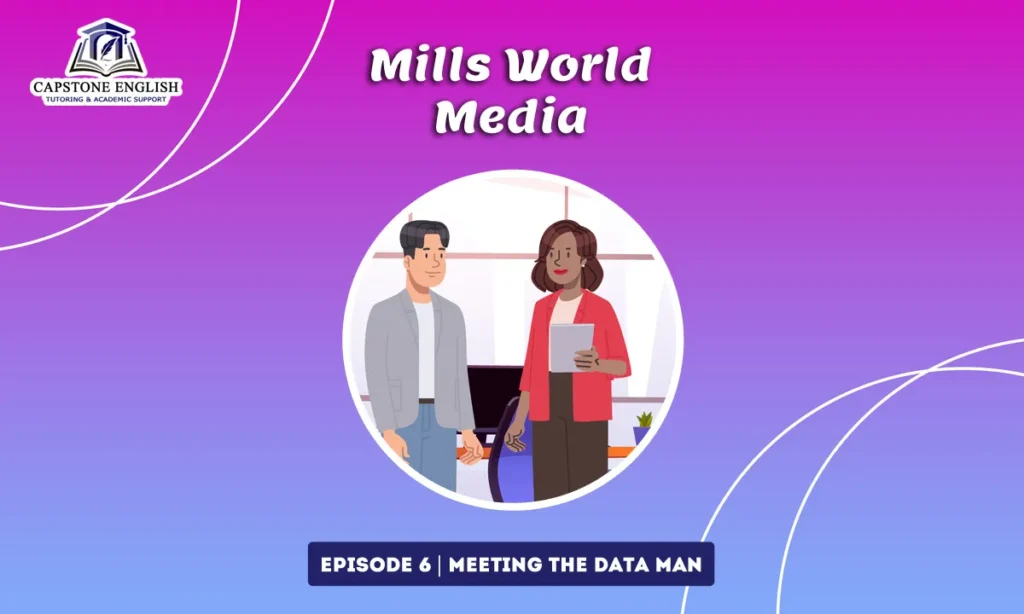
In our latest business English short, Amber demonstrates this skill perfectly. By approaching Kai with a structured plan, she shows that the key to mastering technical jargon isn’t memorizing definitions but learning how to “translate” them into relatable concepts.
Understanding the “Curse of Knowledge”
In a professional setting, we often encounter the “Curse of Knowledge.” This happens when an expert assumes that the people they are talking to have the same background or technical vocabulary that they do. When you are managing concepts beyond your scope, your job is to act as a human filter. You don’t need to know how the algorithm works; you only need to know how the results affect the client’s bottom line.
Asking for analogies — as Amber does, is a powerful professional move. It allows you to maintain your authority in your own field while acknowledging the expertise of others. In the real world, clients rarely care about the math behind a Click-Through Rate (CTR); they care about whether people are “looking at the store window.” By using Kai’s cash register analogy, you turn an abstract number into a tangible business outcome.
Finally, to master technical jargon is to adopt a no-ego approach to learning. The most successful communicators are those who aren’t afraid to ask for a definition in layman’s terms. By asking an expert like Kai to simplify a concept, you ensure that the “translation” is accurate before you pass it on to a client. This prevents the “nodding along” trap, where a lack of clarity leads to misaligned expectations and costly project errors.
Watch Mills World Media Episode 6: Reel & Script

AMBER: Kai Song? I’m Amber Bailey, the independent company trainer working with Mills Media. It’s a pleasure to finally meet you.
KAI: Nice to meet you, Amber. Theo mentioned you were coming by. Please, take a seat.
AMBER: Oh, I’m fine; but thanks anyway. Theo suggested I pick your brain. As you know, I’m developing the training for the junior client managers on handling demanding clients. My focus is giving them the tools for high-stakes negotiation.
KAI: Right. He said you were looking for ways to translate some of our technical concepts into language the clients can easily digest.
AMBER: Precisely. I have two specific goals for this meeting. Goal number one: Can you give me three strong, easy-to-understand analogies you use to explain complex performance metrics? Goal number two: Can you clarify the core difference between CTR and Conversion Rate using layman’s terms?
KAI: That’s a good structure. On goal number one: When I explain the funnel to a client, I tell them: “Traffic is the crowd at the store window, and Conversion is the cash register ringing.” That usually clarifies it.
AMBER: That’s brilliant! Clear and relatable.
KAI: And for goal number two: Think of CTR — that’s the click-through rate — as a test of attraction. How many people were interested enough to look? The Conversion Rate is the test of quality. How many of those interested people actually completed the required action?
AMBER: That simplifies the distinction perfectly. That will be invaluable in the training. Thank you, Kai. You’ve given me a phenomenal starting point.
KAI: Any time. Efficiency is my priority.
Vocabulary Spotlight: Key Business Idioms
To help you sound more like a native speaker, let’s break down the professional expressions used in this dialogue.
| Term | Meaning | Business Context |
| Pick someone’s brain | To ask an expert for their ideas or information. | “I’d like to pick your brain on the new SEO strategy.” |
| Layman’s terms | Simple language that anyone can understand. | “Can you explain this contract in layman’s terms?” |
| Digest | To understand or process complex information. | “I need a moment to digest these quarterly reports.” |
| Invaluable | Extremely useful; indispensable. | “Your feedback on the presentation was invaluable.” |
Episode 6 Takeaways
Here are some points to remember from this week’s episode.
- The “Store Window” Analogy: Use this to explain the difference between simple traffic (people looking) and conversion (people buying).
- Attraction vs. Quality: Frame CTR as a measure of how attractive your “hook” is, while Conversion Rate measures the quality of the offer or product.
- Structured Inquiry: When meeting with an expert, have specific goals (e.g., “Give me three analogies …”) to keep the conversation focused and efficient.
- Digestible Language: Your goal is to make technical metrics digestible so that the client feels empowered, not confused.
Recap
Navigating a multi-departmental workplace requires more than just technical skill; it requires the ability to translate specialized data into common-sense wisdom. By prioritizing clarity over complexity and focusing on the business impact of the numbers, you prove that you have truly succeeded in mastering technical jargon. Ultimately, becoming a “translator” between the data and the client makes you an indispensable leader in any professional environment.
Your Turn!
Mastering technical jargon is a journey, not a destination. We want to hear how you handle “corporate speak” in your office. What is one technical term in your industry that everyone finds confusing? Share an analogy you use to explain a complex part of your job to someone who isn’t an expert!
Watch more Business English Shorts on our YouTube channel to level up your professional communication.