Communication is the engine of business, but if your team isn’t synchronized, that engine is going to stall. One of the most crucial phrases for any professional to master is the alignment check: “Are we on the same page?”
In this Phrase File, we explore how this simple question acts as a “disaster-prevention tool” for your meetings and projects.
The Definition: Finding the Common Ground
When you ask, “Are we on the same page?” you are checking for two things:
- Mutual Understanding: Does everyone understand the facts in the same way?
- Consensus: Does everyone agree on the next steps?
It is the polite way of saying, “I want to make sure no one is confused before we finish our discussion and begin working.”
The “Orchestra” Analogy: Why Harmony Matters
Think of your office like a Symphony Orchestra.
For a piece of music to sound beautiful, every musician—from the violinists to the percussionists—must be looking at the same sheet music. If the flute player is on page five but the conductor is on page seven, the result is literal noise.
In the Office:
- The Sheet Music: Your project plan or strategy.
- Being on the Same Page: Ensuring everyone is playing the same “notes” at the same time.
- The Conductor: That’s you! By asking this question, you ensure the team creates a masterpiece instead of a mess.
Watch Phrase File Episode 3: Reel & Transcript
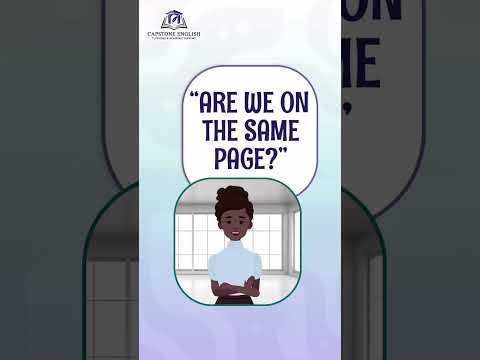
Welcome back to the Phrase File! Have you ever felt confused in a meeting? If so, this phrase is crucial: ‘Are we on the same page?’
This question means: ‘Do we all understand the situation in the same way, and do we agree on the plan?’ It’s used to confirm mutual understanding and alignment.
Imagine your team just decided on a new marketing strategy. You might ask: ‘Before we finish, I need to know — are we on the same page about who is handling the social media?’ It’s checking for consensus.
To see how phrases like this avoid disaster in a fictional office, be sure to watch our upcoming series, ‘Mills World Media’—it puts all this jargon into funny, relatable scenes!
If this reel cleared up any confusion, hit the Like button and Subscribe right now! See you next time!
“Are we on the same page?” More Real World Examples
Here is how to use this phrase to avoid “unprofessional noise” in your communication:
1. To Confirm Responsibility (The “Who” Check)
“Before we finish, I need to know — are we on the same page about who is handling the social media posts for the launch?”
2. To Confirm the Timeline (The “When” Check)
“We’ve discussed a lot today. Just to be sure we’re all on the same page: the final deadline is Friday at noon, correct?”
3. To Clarify a Complex Strategy (The “How” Check)
“I’ve explained the new software update. Are we on the same page regarding the security protocols, or should I go over that part again?”
Synonyms: Other Ways to Say “Are we on the same page?”
In Business English, variety helps you adapt to different room temperatures; whether you are in a formal boardroom or a casual brainstorm. Here are a few alternatives:
- In sync: “I want to make sure the marketing and sales teams are in sync before the launch.” (Great for describing two departments working together).
- Of one mind: “It’s clear that we are of one mind regarding the budget cuts.” (A bit more formal; used when there is strong agreement).
- Seeing eye to eye: “We don’t always see eye to eye on design, but we agree on the functionality.” (Used specifically to describe agreement or shared opinion).
- Aligned: “Are we aligned on the project goals for Q3?” (Very common “corporate-speak” that sounds highly professional).
If you are in a British English environment, you might also hear, “Singing from the same hymn sheet.” It’s the UK equivalent of the orchestra analogy, meaning everyone is following the same set of instructions!
Quick Quiz: Test Your Knowledge
Your Turn!
Have you ever been in a meeting where people were not on the same page? Tell us your story in the comments below!