We have all been there: you spend an hour in a boardroom, everyone agrees the ideas are “great,” but then everyone leaves and… nothing happens. To avoid this productivity trap, you need one crucial closing phrase in your toolkit: “What’s the action item?” In this Phrase File, we break down how this simple question transforms a vague discussion into a concrete result.
- The Definition: From Talk to Task
- The "Architecture" Analogy: Blueprints vs. Bricks
- Watch Phrase File Episode 5: Reel & Transcript
- "What's the Action Item?" More Real World Examples
- Synonyms: Other Ways to Say "What's The Action Item?"
- See it in Action: Mills World Media
- Quick Quiz: Test Your Knowledge
- Your Turn!
The Definition: From Talk to Task
An “action item” is a specific, documented task or step that must be completed by a specific person. In professional English, we use this phrase at the end of a meeting or a brainstorming session. It is the bridge between thinking about a project and actually doing it. When you ask for the action item, you are asking for three things:
- The Task: What exactly needs to be done?
- The Owner: Who is responsible for doing it?
- The Deadline: When does it need to be finished?
The “Architecture” Analogy: Blueprints vs. Bricks
Think of a meeting like an architect’s office. During the meeting, you are looking at blueprints (the discussion). You are dreaming about how the building will look, the color of the walls, and the height of the ceiling. However, you cannot live in a blueprint.
“What’s the action item?” is the moment you move from the office to the construction site.
- The Blueprint (i.e. the discussion): “We should probably build a wall here.”
- The Action Item: “John, please order 500 bricks by Tuesday so we can start building.”
Without action items, your project remains a piece of paper; with them, you actually build the house.
Watch Phrase File Episode 5: Reel & Transcript
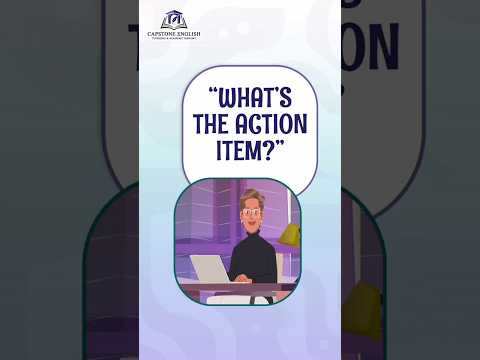
Welcome to Phrase File! Today’s crucial closing phrase is: ‘What’s the action item?’
An ‘action item’ is simply a specific task or step that needs to be completed. This phrase is used at the end of a discussion to ensure clear next steps are defined and assigned.
Let’s say your team just finished a brainstorming session. You wrap up by saying: ‘Great discussion, team. Now, what’s the action item? Who is drafting the proposal and when is the deadline?’
You can see exactly how this organization saves the day for the busy characters in our show. Watch the full series, Mills World Media, for context that really sticks.
“What’s the Action Item?” More Real World Examples
Here is how to use this phrase to keep the momentum going.
1. Wrapping Up a Brainstorm
“Great discussion today, team. We have some brilliant ideas for the campaign. Now, what’s the action item? Who is drafting the proposal, and when is the deadline?”
2. Clarifying a Vague Request
Manager: “We really need to improve our response time to clients.”
You: “I agree. To make sure we move forward, what is the first action item? Should I pull the data from last month’s logs?”
3. In a Follow-up Email
“Thanks for the call earlier. Just to recap, the main action items are for Sarah to contact the vendor and for me to finalize the slide deck by Thursday.”
Synonyms: Other Ways to Say “What’s The Action Item?”
To expand your vocabulary, try these alternatives:
- Takeaway: “What are our key takeaways and tasks from today?”
- Deliverable: “What is the final deliverable for this phase?” (Usually refers to a physical or digital product, like a report).
- To-do: “Let’s list the to-dos before we jump off the call.” (Slightly more casual).
- Milestone: “What is the next milestone we need to hit?” (Refers to a major goal).
See it in Action: Mills World Media
In our animated series, Mills World Media, the characters are constantly balancing high-pressure deadlines and office chaos. Watch the full series to see how “action items” (or the lack of them!) can make or break a team’s success in a fictional marketing agency.
Quick Quiz: Test Your Knowledge
Your Turn!
What is one action item you have on your list for today? Write it in the comments below to practice your business English skills.