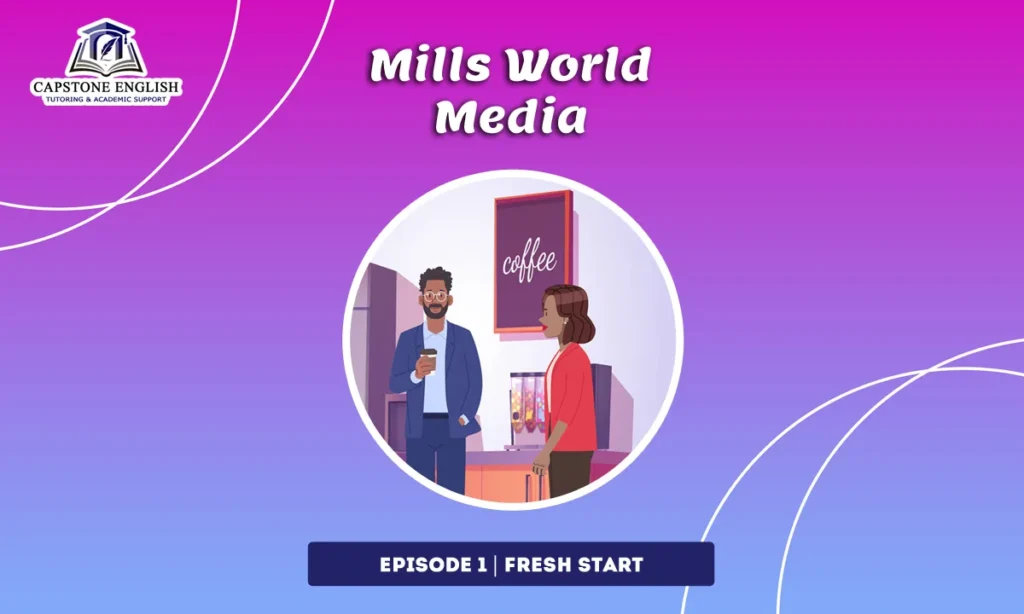
Starting the week on the right foot is about more than just coffee, it’s about building rapport with your colleagues. In the fast-paced world of business, “small talk” serves as the social glue that helps teams collaborate more effectively. In this Mills World Media episode, we join Amber and Theo as they catch up on a busy Monday morning.
Why Small Talk Matters in the Workplace
In a professional environment, small talk is often dismissed as “filler,” but it actually functions as a vital social lubricant that builds psychological safety within a team. Brief exchanges, like the one between Amber and Theo, signal accessibility and openness. When colleagues engage in light conversation before diving into technical tasks, it lowers barriers to communication. This makes it much easier to approach that same person later in the week when a high-stakes issue or a difficult question arises.
From a cultural perspective, mastering the “Monday morning check-in” is a key component of soft skills in the English-speaking workplace. It isn’t just about sharing personal details; it’s about acknowledging the transition from the weekend back into productivity. Successful professionals use these moments to subtly signal their “bandwidth” or current workload. For instance, mentioning a “big client presentation” or “employee onboarding” informs others that you are busy without sounding like you are complaining, allowing coworkers to adjust their expectations for your response times.
To make small talk more effective and less awkward, focus on open-ended questions or positive observations rather than “yes/no” queries. Instead of asking “Are you busy?”, try “What’s the main focus of your week?” This invites the other person to share what matters most to them. Additionally, always aim to end the interaction on a high note. A simple “Good luck with that” or “I’ll let you get to it” provides a graceful exit strategy, ensuring the conversation remains a helpful boost to the day rather than a distraction from work.
Watch Mills World Media Episode 1: Reel & Script
AMBER: Hey Theo! Good morning. Looks like someone’s already on their second cup.
THEO: Amber! Morning. Just trying to jumpstart the week. Big client presentation this afternoon.
AMBER: I’ve got a full day of new employee onboarding myself. Lots of fresh faces to welcome to the team.
THEO: Sounds like a busy but rewarding day. Good luck with the newbies!
AMBER: You too with the presentation. Knock ’em dead.
THEO: Always the plan. Have a great day, Amber.
AMBER: You too, Theo! Catch you later.
Vocabulary Spotlight: Key Business Idioms
To help you sound more like a native speaker, let’s break down the professional expressions used in this dialogue.
| Phrase | Meaning | Example |
| Jumpstart the week | To start something with a lot of energy or a quick boost. | I drink an espresso to jumpstart the week. |
| Onboarding | The process of integrating a new employee into an organization. | Our onboarding process takes three days. |
| Fresh faces | People who are new to a group or organization. | It’s great to see so many fresh faces at the conference. |
| Knock ’em dead | An informal way to say “do a great job” or “impress everyone.” | You’ve prepared well for the pitch, now go knock ’em dead! |
Episode 1 Takeaways
While the conversation between Amber and Theo is brief, it achieves several professional goals.
- Acknowledgment: Recognizing a colleague’s workload builds empathy.
- Energy Matching: Theo uses the “second cup of coffee” observation to pivot into his goals for the day.
- Support: Using phrases like “Knock ’em dead!” fosters a positive team culture.
Bonus Tip
When someone says they are busy, follow Theo’s lead. He describes Amber’s day as “busy but rewarding.” This is a great way to acknowledge hard work while keeping the tone positive and professional.
Recap: Small Talk Strategy
Remember these three simple tips for becoming a natural at engaging and efficient office small talk:
- Observe and Comment: Use simple observations to break the ice naturally.
- Share Your “Big Rock”: Briefly mention your main goal for the day (e.g., “Big client presentation”) to give colleagues context on your schedule.
- End with Encouragement: Use idiomatic expressions like “Good luck!” to leave a lasting positive impression.
Your Turn!
How do you jumpstart your work week? Do you prefer a quiet morning of emails, or do you dive straight into meetings? Let us know in the comments!
Watch more Business English Shorts on our YouTube channel to level up your professional communication.