
In the modern workplace, big-picture thinking is important, but the real answers are often hidden in the details. When a general summary isn’t enough, professional communicators use a specific power phrase: “Drill down.” In this Phrase File, we explore how to move from a high-level view to the granular data that actually drives decision-making.

The Definition: Investigating the Details
To “drill down” is a term originally borrowed from the world of computing and database management, where it describes the act of navigating from a high-level view of information to a more detailed one by clicking through layers of data. In a modern business context, the phrase functions as a verbal signal that a general summary or executive overview is no longer sufficient to solve the problem at hand. When a leader asks to drill down, they are calling for a shift in perspective; moving away from broad generalizations toward specific, actionable evidence.
This phrase is essential because it bridges the gap between surface-level observations and meaningful insights. It implies a systematic, top-down analytical process: you start with a large, aggregated figure (such as total monthly revenue) and bore into it to find the smaller components that make it up (such as individual product performance or specific client feedback). By drilling down, you strip away the fluff to uncover the root causes of success or failure. It is a targeted search for the “fine print” of a situation, ensuring that your team’s next move is based on granular reality rather than vague assumptions.
The “Satellite Map” Analogy: From Orbit to Street View
Imagine you are looking at Google Maps. When you first open the app, you see a satellite view of the entire country. You can see the borders and the big mountain ranges, but you can’t see where the best coffee shop is located. “Drilling down” is the act of zooming in.
- The Overview: You see the whole city (e.g., “Sales are up 10%”).
- The Drill Down: You zoom in until you are at Street View (e.g., “Sales are up because of a specific marketing campaign in the Northeast region targeting 25-year-olds”).
Without drilling down, you are just looking at a map from space. To get where you’re going, you need to zoom in on the details.
Watch Phrase File Episode 6: Reel & Transcript
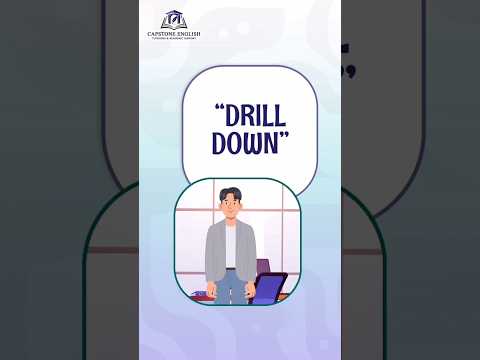
Welcome back to Phrase File! Today, we’re moving past the overview and getting specific with the phrase: ‘Drill down.’
To ‘drill down’ means to investigate a topic or a piece of data more thoroughly, looking closely at the fine details. You use it when you need more information than a high-level summary provides.
If a manager sees that sales are up, but only in one region, they might say: ‘That overall number is good, but we need to drill down into the customer demographics for that region to understand why.’ They need the root cause.
If you found this detailed explanation helpful, don’t let your learning stop here. Like this video and Subscribe to Capstone English now. See you for the next phrase!
Drill Down: More Real World Examples
Here is how you can use this phrase in different formats.
1. Analyzing Performance Data
“Our overall website traffic is high, but we need to drill down into the bounce rate for the landing page to see why people are leaving so quickly.”
2. Solving a Budget Discrepancy
“The department spend is over budget this month. Let’s drill down into the travel expenses and see exactly where that money went.”
3. Understanding Customer Feedback
“The survey shows customers are unhappy with our support. We need to drill down into the specific comments to see if it’s a technical issue or a timing issue.”
Synonyms: Other Ways to Say “Drill Down”
To expand your vocabulary, try these alternatives:
- Deep dive: “Let’s do a deep dive into the Q3 analytics.” (Very common in tech and marketing).
- Examine: “We need to examine the fine print of this contract.”
- Get into the weeds: “I don’t want to get into the weeds right now, but we should look at those numbers later.” (Note: “The weeds” refers to very tiny, sometimes distracting details).
- Go granular: “Can we go a bit more granular on the demographic data?”
Quick Quiz: Test Your Knowledge
Your Turn!
Is there a problem at work that you need to drill down into this week? Practice your English by describing it in the comments below!
If you found this detailed explanation helpful, don’t let your learning stop here. To see how characters in a real-world office manage complex data, watch our animated series Mills World Media. It’s the perfect way to see “drilling down” in action!